
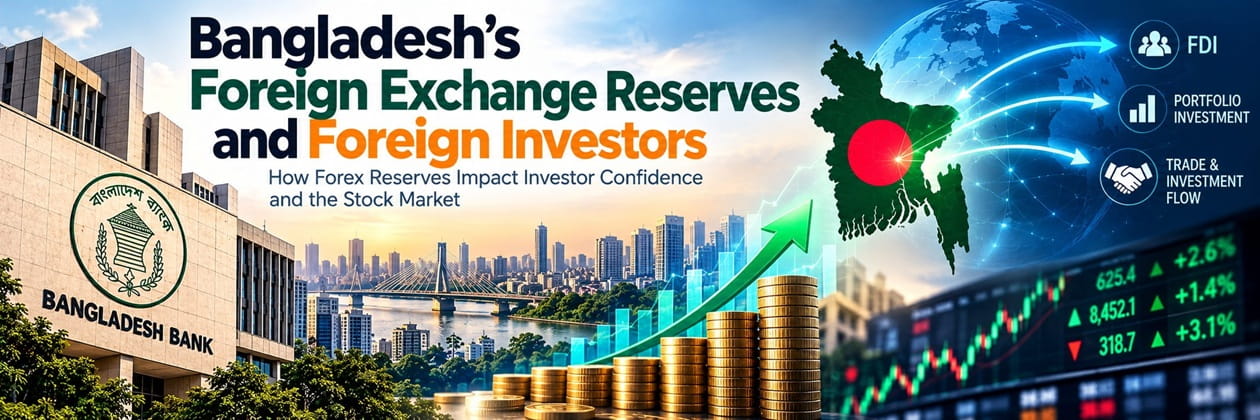
Bangladesh’s Foreign Exchange Reserves Are Rising: What Does It Mean for Foreign Investors?
For international investors, one of the most important questions when evaluating an emerging market is not simply how fast the economy is growing.
It is also whether the country has enough foreign currency to manage external shocks.
In Bangladesh, this question has become particularly important.
After a period of significant pressure on the country's external sector, foreign-exchange reserves have recovered substantially. Remittance inflows remain strong, the exchange rate has become relatively stable, and the balance of payments has improved.
But does a stronger reserve position mean Bangladesh has fully resolved its external-sector risks?
Not necessarily.
For foreign investors, the more important question is:
What is driving the improvement, and how sustainable is it?
Bangladesh’s Foreign-Exchange Reserves Are Recovering
Bangladesh Bank's latest data show gross foreign-exchange reserves of approximately $37.35 billion at the end of August 2026, compared with $36.42 billion at the end of July.
The reserve position has improved considerably from the much lower levels recorded during the previous period of external pressure.
Bangladesh Bank data also show that reserves were approximately $31.17 billion in August 2025.
That means the gross reserve position has increased by more than $6 billion over roughly one year.
For an emerging-market economy, that is a meaningful change.
However, investors should distinguish between gross reserves and reserves measured under the IMF's BPM6 methodology.
At the end of August 2026, Bangladesh Bank reported gross reserves of $37.35 billion and BPM6 reserves of approximately $32.44 billion.
This distinction is important when comparing Bangladesh with other countries.
Why Do Foreign-Exchange Reserves Matter?
Foreign-exchange reserves act as an important financial buffer.
A country needs foreign currency to meet external obligations and support international transactions.
Reserves can help authorities manage pressures associated with:
-
Import payments
-
External debt obligations
-
Energy purchases
-
Exchange-rate volatility
-
Global financial shocks
-
Balance-of-payments pressures
For businesses, adequate foreign-exchange availability can also make it easier to import machinery, raw materials, energy products, and other essential inputs.
That means reserves can influence the real economy as well as financial markets.
The relationship can be summarized simply:
Higher FX Reserves → Greater External Resilience → Lower Currency Pressure → More Predictable Business Environment
The relationship is not automatic, but it is an important part of the macroeconomic picture.
Remittances Are a Major Driver
One of the strongest contributors to Bangladesh's external-sector improvement has been workers' remittances.
Bangladesh Bank recorded remittance inflows of:
-
$2.86 billion in July 2026
-
$2.97 billion in August 2026
-
$2.77 billion in September 2026
These are substantial monthly inflows.
Remittances provide foreign currency to the economy and help support the country's external balance.
They also provide income to millions of households, creating a second economic effect through domestic consumption.
This creates an important chain:
Overseas Employment → Remittances → Foreign Currency → Reserves → Currency Stability → Domestic Consumption
For foreign investors, this makes remittance data an important part of Bangladesh's macroeconomic dashboard.
The Taka Has Become More Stable
Currency movements are particularly important for international investors.
An investor buying a Bangladeshi stock ultimately cares about returns in their own currency.
For example, a stock can rise 10% in taka terms while a significant currency depreciation reduces the investor's effective return after converting the investment back into US dollars.
This is why currency stability matters.
Bangladesh Bank's October 8, 2026 exchange-rate sheet showed a USD/BDT weighted average rate of approximately 123.10.
Recent interbank market data also show the taka trading within a relatively narrow range around the 123-per-dollar level.
This does not eliminate currency risk.
But greater exchange-rate stability can make financial planning more predictable for international investors.
A Stronger Reserve Position Does Not Mean All Risks Are Gone
This is where investors need to be careful.
A country can rebuild its reserves while still experiencing weaknesses elsewhere in the economy.
Bangladesh continues to face:
-
High inflation
-
Weak investment
-
Banking-sector vulnerabilities
-
Energy constraints
-
Low domestic revenue collection
-
Slower economic growth
The World Bank's October 2026 Bangladesh Development Update projects GDP growth of 3.4% in FY2026 and FY2027.
It also reports that Bangladesh's non-performing loan ratio increased to 33.2% in June 2026.
Therefore, stronger reserves should be viewed as one positive component of the macroeconomic picture rather than evidence that all economic problems have disappeared.
What Is Happening With Imports?
Foreign-exchange availability is closely connected to imports.
Bangladesh needs imported energy, machinery, industrial inputs, raw materials, and food products to support economic activity.
Bangladesh Bank reported that imports increased by 10.07% during FY2026, while imports of intermediate goods increased by 15.19%.
This can be interpreted from two perspectives.
Higher imports can increase pressure on foreign exchange.
But higher imports of intermediate goods and capital-related inputs can also indicate stronger industrial activity ahead.
For investors, the composition of imports can therefore be more informative than the headline import number alone.
Why This Matters for Companies
Foreign-exchange conditions can affect companies in very different ways.
Import-Dependent Companies
Businesses that rely heavily on imported raw materials or machinery may benefit from greater foreign-exchange availability.
They may experience fewer difficulties in obtaining the currency required for imports.
Export-Oriented Companies
Exporters generate foreign currency and may have a natural hedge against local-currency movements.
However, their profitability still depends on:
-
Global demand
-
Wage costs
-
Energy costs
-
Imported inputs
-
Shipping expenses
-
International competition
Banks
Banks sit at the center of foreign-exchange transactions.
They are therefore directly affected by changes in:
-
Foreign-currency liquidity
-
Trade finance
-
Import demand
-
Export proceeds
-
Remittance flows
-
Exchange-rate movements
However, the broader banking-sector asset-quality problems remain a major consideration.
Why Foreign Investors Should Watch the Current Account
Foreign-exchange reserves cannot be analyzed in isolation.
Investors should also examine the country's current account.
The current account reflects major international flows involving trade, services, income and transfers.
If exports, remittances and other inflows are strong enough to offset external payments, pressure on reserves can decrease.
If imports and external payments consistently exceed inflows, reserves can come under pressure.
This is why investors should track:
Exports + Remittances + Imports + Current Account + Reserves
rather than looking at reserves alone.
Is Bangladesh Becoming More Resilient?
The latest data suggest that Bangladesh's external position is considerably more stable than it was during the earlier period of pressure.
Strong remittances have helped.
Reserve accumulation has helped.
A relatively stable exchange rate has helped.
But resilience is not the same as complete recovery.
The country still needs stronger economic growth, higher private investment, healthier banks, reliable energy supplies, and stronger fiscal capacity.
The World Bank argues that reforms in the banking, energy and revenue sectors are important for restoring stronger growth.
If those reforms progress successfully, the current improvement in external stability could become a foundation for broader economic recovery.
What Should Foreign Investors Monitor Next?
Investors interested in Bangladesh should keep an eye on several indicators.
1. Foreign-Exchange Reserves
Are reserves continuing to increase?
2. Remittance Growth
Are monthly inflows remaining strong?
3. Export Growth
Is Bangladesh maintaining competitiveness in global markets?
4. Import Growth
Are imports increasing because of productive investment or simply higher consumption?
5. Exchange Rate
Is the taka remaining relatively stable?
6. Inflation
Is the decline in inflation becoming sustainable?
7. Banking-Sector Health
Are non-performing loans beginning to decline?
8. Private Investment
Are businesses increasing capital expenditure?
Together, these indicators can provide a much clearer picture of Bangladesh's economic direction.
The Investment Question
For foreign investors, the most important question is not:
“Are Bangladesh's reserves rising?”
The better question is:
“Can stronger reserves become the foundation for sustainable economic growth?”
If reserve accumulation is supported by strong remittances, competitive exports, productive imports, improving financial-sector stability, and greater private investment, the implications could be significant.
But if reserves improve while domestic investment and productivity remain weak, the economic benefits may be more limited.
That distinction will matter greatly over the coming years.
What Could Make the Story More Attractive?
A stronger investment case could emerge if several developments occur simultaneously:
Stable Currency
Strong Remittances
Growing Exports
Falling Inflation
Banking-Sector Reform
Higher Private Investment
=
A More Sustainable Economic Recovery
This is the combination international investors should watch.
Final Thoughts
Bangladesh's foreign-exchange position has improved significantly.
Gross reserves reached approximately $37.35 billion at the end of August 2026, while remittance inflows remained strong and the taka has traded relatively steadily around the 123-per-dollar level.
These developments provide important support for the country's external stability.
But the bigger investment story is still unfolding.
Bangladesh now faces the challenge of converting improved external stability into stronger domestic investment, healthier financial institutions, higher productivity and sustainable economic growth.
For foreign investors, that transition could be more important than the reserve number itself.
The key question is no longer simply whether Bangladesh can stabilize its foreign-exchange position.
It is whether that stability can become the foundation for the country's next phase of economic growth.
Important Note
This article is provided for educational and informational purposes only. It does not constitute investment advice, an offer to buy or sell securities, or a recommendation regarding any specific company or financial instrument. Foreign investors should conduct independent due diligence and consider applicable regulations, taxation, currency risks, market liquidity, and investment restrictions before investing in Bangladesh.