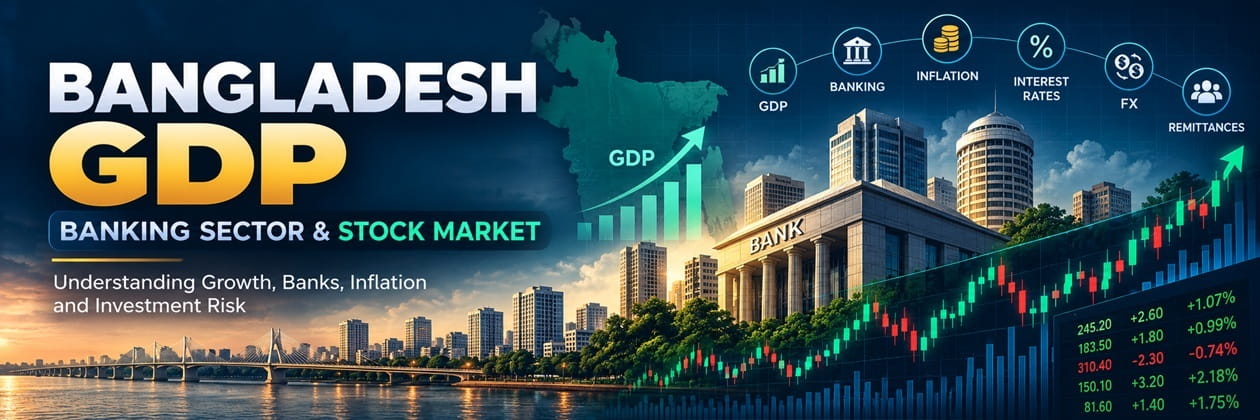
Bangladesh GDP, Banking Sector and the Stock Market: What Foreign Investors Should Know
Bangladesh has long attracted attention as one of South Asia’s major emerging economies, supported by a large domestic market, a young workforce, export-oriented industries, remittance inflows, and a growing private sector.
For foreign investors, however, understanding Bangladesh today requires looking beyond headline GDP growth.
The country is currently going through a period of slower economic growth, elevated inflation, tighter financial conditions, banking-sector stress, and structural reforms. At the same time, improving foreign-exchange reserves and strong remittance inflows are providing important sources of resilience.
These developments matter directly for investors in the Dhaka Stock Exchange (DSE), particularly when evaluating banks, financial institutions, manufacturers, exporters, and consumer-facing companies.
Bangladesh’s Economy at a Glance
Bangladesh’s economy has experienced a significant slowdown over the past few years.
According to the World Bank’s October 2026 Bangladesh Development Update, economic growth is projected at 3.4% in FY2026 and 3.4% in FY2027, with growth potentially improving to 3.9% in FY2028 if energy constraints ease and structural reforms accelerate.
The slowdown reflects several factors, including weaker investment, softer export momentum, elevated inflation, energy-sector constraints, and weaknesses within the financial sector.
This represents a meaningful change from the higher growth rates Bangladesh experienced earlier in the decade.
For investors, the important question is therefore not simply:
Is Bangladesh still growing?
It is:
What is driving growth, where are the weaknesses, and which companies can remain profitable under these conditions?
That distinction is critical when investing in an emerging market.
Why GDP Matters to Stock Market Investors
Gross domestic product, or GDP, measures the overall economic output of a country.
When economic activity expands, companies may benefit from:
-
Higher consumer spending
-
Increased business investment
-
Greater demand for credit
-
Higher industrial production
-
Stronger corporate revenues
-
Greater employment and household income
However, GDP growth does not automatically translate into higher stock prices.
A company can operate in a growing economy and still deliver poor returns if it has excessive debt, weak management, poor asset quality, declining margins, or an unattractive valuation.
This is why foreign investors should treat GDP as a macro-level signal, not as a standalone investment indicator.
The Banking Sector: The Transmission Mechanism of the Economy
Banks occupy a particularly important position in Bangladesh’s economy.
They connect savers with borrowers and provide financing to businesses, households, exporters, importers, and investors.
When banks are financially healthy, they can expand credit and support economic activity.
When banks face serious asset-quality problems, however, the opposite can happen.
Weak banks may become more cautious about lending. Businesses may face difficulty obtaining financing. Investment can slow, and economic growth can weaken further.
This creates an important feedback loop:
Economic growth → Credit demand → Bank lending → Business activity → Corporate earnings → Investment
But the relationship can also work in reverse:
Weak banks → Weak credit growth → Lower investment → Slower business activity → Weaker economic growth
This is one of the most important relationships for investors to understand in Bangladesh.
Banking-Sector Stress Is a Major Investment Issue
Bangladesh’s banking sector is currently facing significant asset-quality challenges.
According to Bangladesh Bank, the gross non-performing loan ratio reached 30.6% at the end of December 2025, up from 20.2% a year earlier.
The World Bank subsequently reported that the ratio increased further to 33.2% in June 2026.
This is a major consideration for anyone analyzing Bangladeshi bank stocks.
High non-performing loans can affect banks through:
-
Higher provisioning requirements
-
Lower profitability
-
Reduced lending capacity
-
Pressure on capital
-
Weaker investor confidence
-
Greater balance-sheet uncertainty
For a foreign investor, a bank should therefore never be evaluated simply by looking at its share price or price-to-book ratio.
The quality of its loan portfolio matters just as much.
Interest Rates and the Cost of Capital
Monetary policy is another important factor.
As of October 2026, Bangladesh Bank’s policy rate stands at 9.50%, while the Standing Lending Facility is 11.00% and the Standing Deposit Facility is 7.50%.
High interest rates can help contain inflation, but they can also increase the cost of borrowing.
For businesses, this may mean:
-
Higher financing costs
-
Lower investment
-
Pressure on profit margins
-
Slower expansion
-
Reduced demand for credit
For banks, the effect can be more complicated.
Higher lending rates may support interest income, but weaker credit demand and rising credit risk can offset some of the benefits.
Investors therefore need to examine both sides of the equation rather than assuming that higher interest rates are automatically positive or negative for banks.
Inflation Remains a Key Risk
Inflation continues to be one of Bangladesh’s most important macroeconomic challenges.
According to the latest Bangladesh Bureau of Statistics data reported in October 2026, headline inflation reached 8.34% in September 2026, compared with 8.26% in August.
Food inflation stood at 7.22%, while non-food inflation remained considerably higher at 9.30%.
Persistent inflation can affect the stock market in several ways.
Higher prices reduce household purchasing power.
Higher input costs can pressure corporate margins.
Higher interest rates can increase financing costs.
And prolonged inflation can reduce the attractiveness of riskier assets if investors can earn comparatively attractive returns from fixed-income instruments.
For foreign investors, inflation should therefore be monitored alongside earnings growth and valuation.
The Bangladesh Taka and Foreign Investors
Currency movements add another layer of risk for international investors.
For an investor whose base currency is US dollars, investment performance depends on both:
-
The performance of the underlying Bangladeshi stock
-
The movement of the Bangladeshi taka against the investor’s home currency
Bangladesh Bank’s reference exchange rate was around BDT 123 per US dollar in early October 2026.
This means a foreign investor can potentially earn a positive return in local-currency terms while receiving a smaller return after currency conversion.
Currency risk is therefore an important part of evaluating Bangladesh as an investment destination.
There Are Still Reasons to Watch Bangladesh
The current economic challenges do not mean Bangladesh lacks investment opportunities.
The World Bank notes that the external sector has shown resilience, supported by strong remittance inflows and improving foreign-exchange reserves.
Bangladesh also retains several structural advantages:
-
A large domestic consumer market
-
A young labor force
-
A globally important garment-export industry
-
Growing pharmaceutical and healthcare capabilities
-
Expanding digital and technology adoption
-
Significant remittance inflows
-
Increasing financial inclusion
-
Long-term infrastructure and urbanization needs
These structural characteristics can create opportunities even during periods of macroeconomic stress.
The key issue is identifying businesses that are financially strong enough to benefit from the eventual recovery.
Which Sectors Should Foreign Investors Watch?
Different sectors respond differently to Bangladesh’s economic cycle.
Banks and Financial Institutions
Banks provide exposure to domestic credit growth and economic activity.
However, investors should pay particular attention to:
-
Non-performing loans
-
Provision coverage
-
Capital adequacy
-
Return on equity
-
Net interest income
-
Deposit growth
-
Loan growth
-
Liquidity
-
Corporate governance
In the current environment, balance-sheet quality should be considered more important than simply finding the cheapest bank stock.
Pharmaceuticals
Bangladesh has developed a significant domestic pharmaceutical industry.
Investors may examine companies based on:
-
Revenue growth
-
Export exposure
-
Product portfolio
-
Operating margins
-
Research and development
-
Regulatory compliance
-
Balance-sheet strength
Textiles and Apparel
The apparel industry remains central to Bangladesh’s export economy.
However, exporters can be sensitive to:
-
Energy costs
-
Wage costs
-
Global consumer demand
-
Currency movements
-
Raw-material prices
-
International trade conditions
Companies with strong customers, efficient operations and healthy balance sheets may be better positioned to handle these pressures.
Consumer Businesses
A large domestic population provides a long-term consumer opportunity.
But elevated inflation can temporarily weaken real purchasing power.
Investors should therefore distinguish between:
long-term consumption growth
and
short-term consumer spending pressure.
Technology and Digital Businesses
Digital adoption continues to create opportunities across financial services, payments, commerce, software, telecommunications and other technology-enabled industries.
For foreign investors, this area may provide exposure to structural growth rather than simply the traditional economic cycle.
GDP Growth Alone Is Not Enough
One of the most common mistakes in emerging-market investing is assuming that higher GDP automatically means higher stock-market returns.
It does not.
Stock prices reflect expectations about future earnings, risk, liquidity, interest rates and valuation.
Consider two companies operating in the same economy.
Company A has:
-
Strong revenue growth
-
Low leverage
-
Healthy cash flow
-
Good governance
-
High return on equity
-
A reasonable valuation
Company B has:
-
Weak earnings
-
High debt
-
Poor asset quality
-
Weak governance
-
Declining margins
-
An expensive valuation
Both companies are exposed to the same GDP growth rate.
Their investment outcomes can still be completely different.
This is why macroeconomic analysis should be combined with company-level research.
A Practical Framework for Foreign Investors
Foreign investors researching Bangladesh can use a five-layer framework.
1. Start With the Macro Economy
Track:
-
GDP growth
-
Inflation
-
Interest rates
-
Foreign-exchange reserves
-
Exchange rates
-
Remittances
-
Export growth
-
Import trends
2. Understand the Sector
Ask:
-
Is the sector expanding or contracting?
-
Is demand cyclical or structural?
-
How sensitive is it to interest rates?
-
How dependent is it on imports?
-
How exposed is it to energy costs?
3. Analyze the Company
Review:
-
Revenue
-
Earnings
-
Cash flow
-
Debt
-
Return on equity
-
Margins
-
Dividend history
-
Asset quality where relevant
-
Corporate governance
4. Evaluate the Valuation
A good company can still be a poor investment if purchased at an excessive valuation.
Useful metrics may include:
-
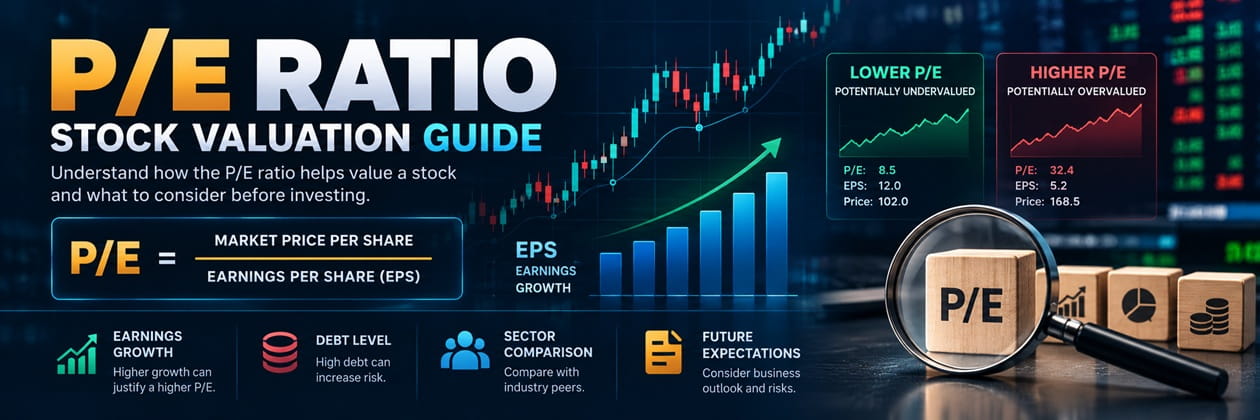
P/E
-
P/B
-
EV/EBITDA
-
Dividend yield
-
Earnings growth
-
Return on equity
These metrics should always be compared with the company’s own history and relevant sector peers.
5. Consider Currency and Liquidity Risk
Foreign investors should also assess:
-
BDT/USD movements
-
Trading liquidity
-
Foreign ownership restrictions
-
Repatriation procedures
-
Settlement arrangements
-
Market depth
-
Regulatory requirements
These factors can materially affect the real-world investment experience.
What Could Improve the Outlook?
Bangladesh’s medium-term outlook will depend heavily on the success of economic and financial reforms.
The World Bank highlights reforms in the banking sector, energy sector and domestic revenue mobilization as particularly important for restoring stronger growth. It also expects growth to improve to 3.9% in FY2028 if energy constraints ease and reforms accelerate.
For investors, successful reforms could potentially improve:
-
Credit allocation
-
Banking-sector stability
-
Investor confidence
-
Private investment
-
Corporate activity
-
Government finances
-
Long-term economic growth
The opposite is also true.
Delayed reforms could prolong financial-sector stress, weak investment and subdued growth.
The Bigger Investment Picture
Bangladesh should not be viewed simply as a high-growth story or a distressed market.
It is currently a reform-sensitive emerging market.
The country still has substantial long-term economic potential, but the near-term environment requires careful analysis.
For foreign investors, this creates an interesting investment landscape.
The most attractive opportunities may not necessarily be found in the companies with the lowest share prices.
Instead, investors may want to focus on businesses with:
strong balance sheets + sustainable earnings + competitive advantages + sound governance + reasonable valuations.
At the macro level, the key indicators to monitor are equally clear:
GDP growth + inflation + interest rates + banking-sector health + foreign exchange + remittances + exports.
Together, these indicators provide a much more complete picture of Bangladesh’s investment environment than GDP growth alone.
Final Thoughts
Bangladesh remains an important emerging-market economy, but its investment story is evolving.
The latest data show a combination of slower economic growth, elevated inflation, high interest rates and significant banking-sector vulnerabilities. At the same time, resilient remittances, improving foreign-exchange reserves and the potential for structural reforms provide reasons for long-term investors to continue monitoring the market.
For foreign investors, the opportunity is therefore not simply about predicting whether Bangladesh’s GDP will rise or fall.
It is about understanding which businesses can survive the current cycle, which companies can benefit from future reforms, and whether their market valuations adequately reflect both the opportunities and the risks.
Bangladesh’s next phase of economic development may ultimately depend on how successfully it addresses its financial, energy and institutional challenges.
For investors willing to conduct disciplined research, that transition could create opportunities across multiple sectors of the Dhaka Stock Exchange.
Important Note
This article is provided for educational and informational purposes only. It does not constitute investment advice, an offer to buy or sell securities, or a recommendation regarding any specific company or financial instrument. Foreign investors should conduct independent due diligence and consider applicable laws, regulations, taxation, currency risks and investment restrictions before investing in Bangladesh.