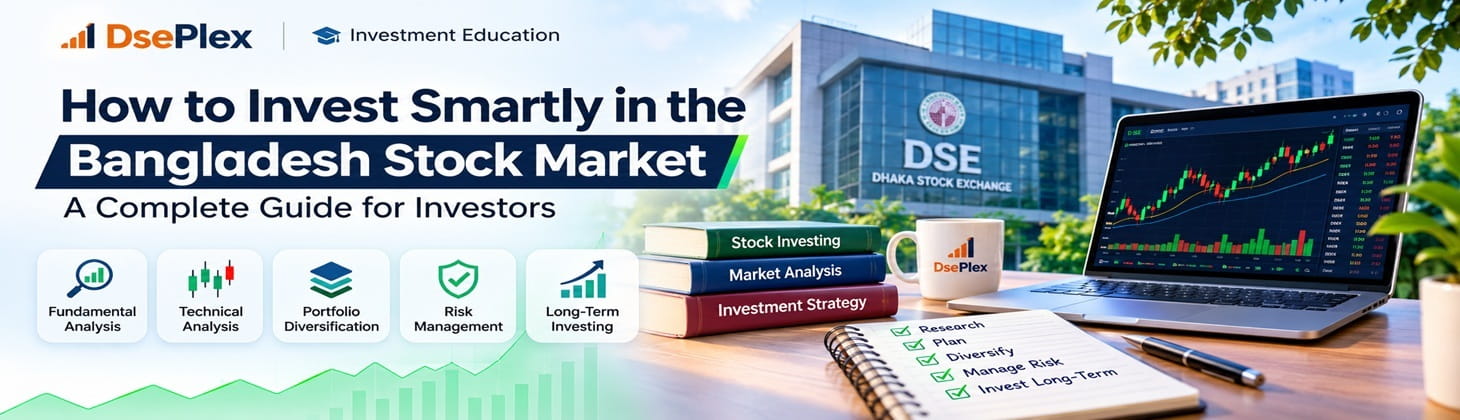
How to Invest Smartly in the Bangladesh Stock Market: A Complete Guide for Investors
The stock market offers significant opportunities to build long-term wealth, but successful investing requires more than simply buying shares when prices are rising. It requires research, patience, discipline, and a well-defined investment strategy.
For investors in Bangladesh, understanding the Dhaka Stock Exchange (DSE), analyzing listed companies, and managing investment risks are essential steps toward making informed financial decisions.
In this guide, we explore practical strategies that can help investors make smarter decisions in the Bangladesh stock market.
1. Understand the Fundamentals Before Investing
Before purchasing any stock, investors should understand the company's financial health and business performance.
Fundamental analysis helps evaluate whether a company is financially stable and potentially undervalued.
Some important financial indicators include:
-
Earnings Per Share (EPS): Measures how much profit a company generates per outstanding share.
-
Price-to-Earnings Ratio (P/E): Helps assess a stock's valuation relative to its earnings.
-
Net Asset Value (NAV): Provides insight into the company's net asset value per share.
-
Return on Equity (ROE): Measures how efficiently a company generates profit from shareholders' equity.
-
Dividend Yield: Indicates the annual dividend relative to the current share price.
-
Debt-to-Equity Ratio: Helps evaluate a company's financial leverage.
Never rely on a single financial indicator. A comprehensive evaluation provides a better understanding of a company's overall position.
2. Learn to Read Price Charts and Market Trends
Understanding price movements is another important part of stock market investing.
Technical analysis helps investors study historical price movements, trading volume, and market trends to identify potential opportunities.
Some commonly used technical indicators include:
-
Moving Average (MA)
-
Relative Strength Index (RSI)
-
Moving Average Convergence Divergence (MACD)
-
Bollinger Bands
-
Average True Range (ATR)
For example, moving averages can help identify potential market trends, while RSI can provide insights into momentum conditions.
However, technical indicators should not be treated as guaranteed buy or sell signals. They work best when combined with proper risk management and fundamental research.
3. Diversify Your Investment Portfolio
One of the most important principles of investing is diversification.
Investing all your money in a single company or industry can expose your portfolio to unnecessary risks.
A diversified portfolio may include companies from different sectors, such as:
-
Banking and Financial Institutions
-
Pharmaceuticals and Chemicals
-
Textiles and Garments
-
Engineering
-
Telecommunications
-
Information Technology
-
Food and Allied Industries
Diversification does not eliminate investment risk, but it can help reduce the impact of poor performance in a particular company or sector.
Your asset allocation should reflect your financial goals, investment horizon, and risk tolerance.
4. Avoid Emotional Investment Decisions
Fear and greed are two of the biggest challenges investors face.
Many investors buy shares simply because prices are rising rapidly. Others sell quality stocks during temporary market declines because of panic.
Both behaviors can lead to poor investment decisions.
Instead, consider following these principles:
-
Develop an investment plan before entering the market.
-
Avoid buying stocks based solely on rumors or social media recommendations.
-
Define your risk tolerance and investment objectives.
-
Evaluate company fundamentals before making decisions.
-
Review your portfolio periodically rather than reacting to every market movement.
Successful investing is not about predicting every market movement. It is about following a consistent and disciplined process.
5. Understand Risk Management
Protecting your capital is just as important as generating returns.
Before investing in any company, consider:
-
How much capital are you willing to risk?
-
What percentage of your portfolio is allocated to one stock?
-
Is the company financially stable?
-
Are there any significant corporate or industry-related risks?
-
Does the investment match your financial objectives?
Investors should also maintain sufficient liquidity instead of committing all available capital to the stock market.
Remember, higher potential returns often come with higher risks.
6. Use Data and Research Instead of Guesswork
Modern investors have access to more financial information and analytical tools than ever before.
Instead of manually collecting information from multiple sources, investors can use dedicated research platforms to organize market data, analyze companies, monitor price movements, and evaluate portfolio performance.
DsePlex provides a range of resources designed to support investors in the Bangladesh stock market, including:
-
Market Analysis: Explore market movements and sector performance.
-
Stock Screener: Discover companies using different financial and technical criteria.
-
Advanced Charts: Study price trends and technical indicators.
-
AI Market Scanner: Explore AI-assisted market insights and stock analysis.
-
Portfolio Management: Monitor holdings and evaluate portfolio performance.
-
Investment Calculators: Use analytical tools to support financial planning.
-
Investment Education: Improve your understanding of stock market concepts and strategies.
Using research tools does not guarantee profitable investments. However, structured information and systematic analysis can help investors make more informed decisions.
7. Think Long-Term, Not Just About Daily Price Movements
Short-term market fluctuations are a normal part of stock market investing.
Investors who focus exclusively on daily price movements may overlook the long-term potential of fundamentally strong businesses.
A long-term investment approach generally involves:
-
Identifying financially sound companies.
-
Understanding their business models and growth prospects.
-
Evaluating their financial performance.
-
Monitoring corporate announcements and industry developments.
-
Reviewing portfolio allocation periodically.
Patience and consistency are important, but investors should continue evaluating whether their original investment thesis remains valid.
Final Thoughts
Successful stock market investing is not about finding a guaranteed winning stock. It is about making informed decisions, understanding risk, maintaining discipline, and continuously improving your investment knowledge.
For investors participating in the Dhaka Stock Exchange, combining fundamental analysis, technical research, portfolio diversification, and risk management can create a more structured approach to investing.
The best investment decision is not necessarily the one that generates the highest immediate return. It is the one that aligns with your financial goals, investment strategy, and ability to manage risk.
Make informed decisions. Analyze before investing. Build your investment knowledge with DsePlex.
Explore more investment research and analytical tools at DsePlex.
Disclaimer: This article is for educational and informational purposes only. It does not constitute financial, investment, or trading advice. Stock market investments involve risk, and investors should conduct their own research before making investment decisions.