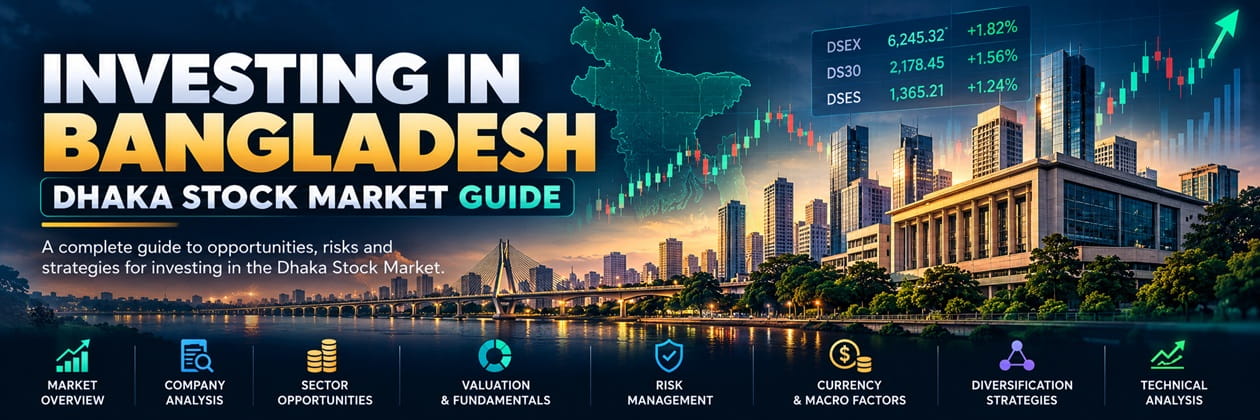
Investing in Bangladesh: A Practical Guide to Understanding the Dhaka Stock Market
For international investors looking beyond developed markets, emerging economies can provide opportunities that are often different from those found in larger global markets.
Bangladesh is one such market.
Its economy includes a diverse range of industries, including banking, pharmaceuticals, telecommunications, textiles, consumer goods, engineering, financial services, and other businesses.
For investors unfamiliar with Bangladesh, however, entering the market requires more than simply identifying companies with attractive share prices.
Understanding the local market structure, business environment, company fundamentals, liquidity, valuation, and investment risks is essential.
This guide provides a practical framework for approaching the Bangladesh stock market as an international investor.
1. Start by Understanding the Market
The primary stock exchange in Bangladesh is the Dhaka Stock Exchange, commonly known as the DSE.
Before evaluating individual companies, international investors should understand how the local equity market operates.
Important areas to understand include:
- Market structure
- Trading mechanisms
- Listed companies
- Market indices
- Sector composition
- Trading liquidity
- Settlement procedures
- Market regulations
- Foreign investment requirements
The objective is not to memorize every market rule.
Instead, investors should develop a basic understanding of how the market functions before committing capital.
2. Look at Bangladesh as an Emerging Market
Bangladesh should be evaluated differently from a mature developed equity market.
Emerging markets can offer attractive growth opportunities, but they may also involve additional risks.
These can include:
- Lower market liquidity
- Greater price volatility
- Currency risk
- Regulatory changes
- Corporate governance concerns
- Limited availability of certain types of information
- Sector concentration
- Differences in accounting and disclosure practices
This does not automatically make the market unattractive.
It simply means that international investors need to incorporate these factors into their investment process.
3. Identify the Sectors You Understand
One of the easiest ways to begin researching the Bangladesh market is through sector analysis.
Different industries can behave very differently depending on economic conditions.
For example, investors may research sectors such as:
Banking and Financial Services
Banks and financial institutions can provide exposure to domestic economic activity, credit growth, interest-rate conditions, and financial-sector development.
Pharmaceuticals
Bangladesh has an established pharmaceutical industry with companies serving both domestic and international markets.
Textiles and Apparel
The textile and garment sector is an important part of Bangladesh's economy and offers exposure to the country's manufacturing and export industries.
Telecommunications
Telecommunications companies provide exposure to one of the country's most important consumer and infrastructure markets.
Consumer and Manufacturing Companies
Consumer goods, engineering, and other manufacturing businesses can provide additional exposure to domestic consumption and industrial activity.
The important point is not to invest simply because a sector is popular.
Instead, identify industries you can understand and analyze effectively.
4. Research the Business Before Researching the Stock
A common mistake among new investors is to start with the share price.
A better approach is to start with the business.
Ask:
What does the company actually do?
Then consider:
- How does it make money?
- Who are its customers?
- What is its competitive position?
- Is revenue growing?
- Are profit margins improving?
- How much debt does it have?
- How strong is its cash flow?
- What are the major risks?
- Does the business have room to grow?
A stock represents ownership in a business.
Understanding that business should come before attempting to predict its share price.
5. Examine Financial Performance
Once you understand the business, examine its financial history.
Important metrics may include:
- Revenue
- Net profit
- Earnings per share
- Return on equity
- Profit margins
- Debt
- Operating cash flow
- Dividend history
Do not rely on a single year's results.
Looking at several years of financial performance can help reveal whether the company's growth is consistent or simply the result of temporary conditions.
6. Do Not Confuse a Low Share Price With a Cheap Company
A share trading at a low nominal price is not necessarily undervalued.
For example, a company trading at a relatively low share price may still be expensive relative to its earnings and assets.
Conversely, a company with a higher share price may be more attractively valued.
This is why investors should focus on valuation, rather than the absolute share price.
Common valuation measures include:
- Price-to-Earnings ratio
- Price-to-Book ratio
- Dividend yield
- Earnings growth
- Return on equity
These metrics should be evaluated together rather than independently.
7. Compare Companies Within Their Industry
Comparing companies across completely different industries can produce misleading conclusions.
A bank and a pharmaceutical company have different business models, capital structures, risks, and profitability characteristics.
A more useful approach is often to compare companies within the same sector.
Consider:
- Valuation
- Profitability
- Growth
- Debt
- Dividend policy
- Market position
- Business quality
This can help investors determine which companies appear relatively attractive within their own industry.
8. Liquidity Matters
Liquidity is particularly important for international investors.
A company may look attractive based on its fundamentals, but if trading activity is limited, entering or exiting a position may be more difficult.
Before investing, consider:
- Average trading volume
- Trading frequency
- Bid-ask conditions
- Position size
- Historical liquidity
Large positions should receive additional attention because the ability to enter or exit efficiently can become an important part of the investment decision.
9. Consider Currency Risk
International investors are exposed to more than the performance of the underlying stock.
They may also be exposed to currency movements.
An investment can perform well in local-currency terms while producing a different return when converted into the investor's home currency.
Therefore, international investors should consider:
Local stock return + currency movement + transaction costs
rather than focusing only on the local share price.
Currency risk does not necessarily mean avoiding the market.
It simply needs to be included in the overall investment analysis.
10. Understand Corporate Governance
Corporate governance should be an important part of emerging-market research.
Investors should examine:
- Board structure
- Ownership concentration
- Related-party transactions
- Financial disclosures
- Dividend practices
- Management quality
- Regulatory compliance
A company with attractive financial numbers but weak governance may carry risks that are not immediately visible in a valuation ratio.
Good investment research therefore goes beyond financial statements.
11. Build a Watchlist Before Building a Portfolio
International investors do not need to invest immediately.
A better approach can be to create a research watchlist first.
For example:
Step 1: Identify promising sectors.
Step 2: Select companies within those sectors.
Step 3: Study their financial performance.
Step 4: Compare valuations.
Step 5: Monitor liquidity.
Step 6: Track company developments.
Step 7: Wait for an attractive valuation or suitable entry opportunity.
This creates a research pipeline rather than forcing an investment decision.
12. Avoid Concentrating Your Entire Portfolio
Emerging-market investing can involve additional uncertainty.
Therefore, concentration risk deserves careful attention.
Instead of relying heavily on a single company, investors may consider diversification across:
- Companies
- Sectors
- Investment themes
- Asset classes
- Geographic markets
Diversification cannot eliminate investment risk, but it can reduce the impact of a single company or sector performing poorly.
13. Think in Terms of Risk-Adjusted Returns
The highest potential return is not always the best investment opportunity.
Suppose two companies have similar expected returns.
If one has:
- Stronger financials
- Better liquidity
- Lower debt
- More stable earnings
- Better governance
it may offer a more attractive risk-adjusted opportunity.
The objective should not simply be:
“How much can I make?”
A better question is:
“Is the potential return sufficient for the risks I am taking?”
14. Use Both Fundamental and Technical Analysis
Fundamental analysis can help answer:
What is the quality and value of this business?
Technical analysis can help answer:
What is the market currently doing with this stock?
The two approaches can complement each other.
For example:
Fundamental Analysis → Business Quality
Valuation → Price Relative to Fundamentals
Technical Analysis → Market Trend and Price Behavior
Risk Management → Position and Capital Allocation
Combining these perspectives can create a more structured investment process.
15. Do Not Build an Investment Strategy Around Short-Term Predictions
Trying to predict every market movement is difficult.
Instead, develop a repeatable process.
A practical framework could be:
Research → Analyze → Value → Manage Risk → Invest → Monitor → Review
If the original investment thesis remains valid, short-term price fluctuations may not necessarily require immediate action.
If the fundamental thesis changes, however, the investment should be reassessed.
16. Keep an Investment Journal
An investment journal can be particularly useful for international investors entering an unfamiliar market.
For every investment, record:
- Investment thesis
- Purchase price
- Position size
- Expected catalysts
- Key risks
- Valuation assumptions
- Exit conditions
- Subsequent performance
Over time, this creates a record of your decision-making process.
The goal is not simply to track profits.
It is to determine whether your investment process itself is improving.
17. Use Reliable Research Tools
International investors may find it difficult to gather and organize information about an unfamiliar market.
Research platforms can help bring together:
- Market data
- Company information
- Financial metrics
- Charts
- Screening tools
- Portfolio analysis
- Investment research
DsePlex is designed to provide investors with market analysis tools, stock research capabilities, advanced charts, screening features, portfolio tools, and investment-focused resources for the Bangladesh market.
However, no platform should replace independent research and judgment.
A Practical Framework for International Investors
A simple approach could look like this:
Stage 1 — Understand
Learn how the Bangladesh stock market works.
Stage 2 — Discover
Identify sectors and companies worth researching.
Stage 3 — Research
Study business models and financial performance.
Stage 4 — Value
Evaluate whether the current market price appears reasonable relative to fundamentals.
Stage 5 — Assess Risk
Consider liquidity, currency, governance, business, and market risks.
Stage 6 — Build
Create a diversified portfolio based on your objectives and risk tolerance.
Stage 7 — Monitor
Track both company fundamentals and market conditions.
Stage 8 — Review
Regularly evaluate whether the original investment thesis remains valid.
Final Thoughts
The Bangladesh stock market can be an interesting market for international investors seeking exposure to an emerging economy.
But successful investing should not begin with the question:
“Which stock will rise next?”
A better starting point is:
“Which businesses can I understand, value, and monitor effectively?”
The strongest investment approach is usually built around research, valuation, diversification, risk management, and patience.
For international investors, the additional dimensions of currency, liquidity, regulation, and corporate governance make proper research even more important.
Bangladesh should not be viewed simply as a source of high-return opportunities.
It should be approached as a market that requires local understanding, disciplined analysis, and careful risk management.
Disclaimer: This article is provided for educational and informational purposes only. It does not constitute investment, financial, legal, tax, or regulatory advice, nor does it constitute an offer or solicitation to buy or sell any security. International investors should independently assess applicable regulations, eligibility requirements, taxes, currency risks, and other considerations before investing in Bangladesh.